

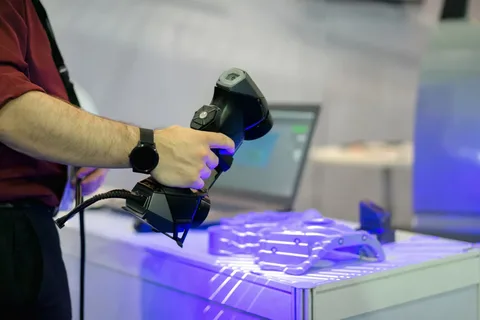
The world of 3d scanning technology has evolved rapidly over the past few years, opening new possibilities in fields ranging from manufacturing and healthcare to entertainment and architecture. As advancements continue to unfold, industry professionals and innovators alike are asking, What’s next for 3D scanning technology? To answer that question, we will explore the latest trends and innovations that are shaping the future of 3D scanning and how they will impact various industries.
1. The Rise of Mobile 3D Scanning
One of the most exciting developments in the field of 3D scanning is the shift towards mobile and handheld devices. Traditionally, 3D scanners required bulky equipment and professional setups, limiting their accessibility. However, with the growing power of smartphones and tablets, mobile 3D scanning is becoming more practical for both professionals and everyday users.
Advancements in Hardware
Companies are designing smaller, more portable 3D scanners that integrate seamlessly with mobile devices. This not only makes 3D scanning more accessible but also allows for real-time scanning and immediate data processing. For example, some smartphones now feature LiDAR sensors that can capture detailed 3D scans of environments in seconds, providing users with high-quality scans without the need for expensive hardware.
Implications for Industries
From interior design to construction, mobile 3D scanning opens up new possibilities for on-the-go applications. Field workers can scan environments and objects directly from their smartphones, providing immediate data for analysis or further processing. This ease of use could revolutionize industries where time and accessibility are crucial, such as real estate, engineering, and even archaeology.
2. Integration of AI and Machine Learning
Artificial intelligence (AI) and machine learning are beginning to play a significant role in the development of 3D scanning technology. These technologies allow scanners to process and analyze data more effectively, enhancing the accuracy and efficiency of scans.
Improved Scan Quality and Accuracy
AI-driven algorithms are already being used to refine scan data, identifying and correcting errors in real-time. For instance, AI can detect missing or incomplete scans and automatically fill in gaps, making the final 3D model more accurate. This is particularly beneficial in industries like healthcare, where precision is critical.
Faster Data Processing
Machine learning models are also being used to speed up the processing of large amounts of data collected during scans. AI can help filter out irrelevant information, focusing only on the most important details, which can significantly reduce the time required for data processing. This will make 3D scanning more efficient for applications in manufacturing, product design, and even digital twins of physical environments.
3. 3D Scanning for Healthcare: Revolutionizing Medical Imaging
The healthcare sector has long benefited from 3D imaging technologies, but the next frontier for 3D scanning is even more promising. With advancements in resolution, portability, and software integration, 3D scanning is poised to revolutionize medical diagnostics, treatment planning, and even surgery.
Customized Medical Devices and Prosthetics
One of the most impactful innovations is the use of 3D scanning to create personalized medical devices, such as prosthetics and orthotics. By scanning a patient’s body, manufacturers can create devices that perfectly fit the individual, improving comfort and functionality. This trend is also pushing the boundaries of 3D bioprinting, where scanned tissue structures could eventually be used to print organs or other body parts.
Enhanced Diagnostics and Treatment Planning
3D scanning technology is also being integrated into diagnostic tools, such as CT and MRI scans, allowing for more precise and detailed images of the human body. With 3D models, doctors can better plan surgeries, visualize potential risks, and even practice procedures before operating on a patient. This could significantly reduce complications during surgeries and improve overall patient outcomes.
4. The Future of 3D Scanning in Virtual Reality (VR) and Augmented Reality (AR)
Another exciting trend in 3D scanning technology is its integration with virtual reality (VR) and augmented reality (AR). As these technologies continue to mature, they are becoming powerful tools for both entertainment and industrial applications.
Creating Immersive Virtual Worlds
In the entertainment industry, 3D scanning is already being used to create hyper-realistic models for video games and movies. With the growth of VR, these models can now be used to build fully immersive environments that users can explore in real-time. Game developers, for example, can scan real-world objects and locations to recreate them in virtual worlds, providing users with a more realistic experience.
Enhancing AR Experiences
Similarly, 3D scanning is enhancing AR experiences by allowing virtual objects to interact with the real world. For example, retailers are using 3D scanning to allow customers to “try on” clothes or visualize how furniture would look in their homes. By scanning a physical space, AR applications can place digital items seamlessly into that environment, offering highly interactive and engaging experiences.
5. Sustainability and Eco-Friendly 3D Scanning
As industries strive for sustainability, 3D scanning is helping to reduce waste and improve efficiency in manufacturing and construction. By creating highly accurate 3D models of objects and environments, businesses can minimize errors, reduce the need for physical prototypes, and optimize the use of materials.
Efficient Resource Management
For example, in the construction industry, 3D scanning allows for precise measurements and planning, reducing material waste during the building process. Similarly, in manufacturing, 3D scanning can be used to create accurate designs, allowing for more efficient production and less waste of raw materials.
Supporting Green Technologies
In addition, 3D scanning plays a critical role in the development of green technologies, such as renewable energy systems. By creating detailed models of wind turbines, solar panels, or even entire ecosystems, 3D scanners enable more precise designs and better performance. This contributes to the development of more energy-efficient and environmentally friendly technologies.
Conclusion: What’s Next for 3D Scanning Technology?
As we look to the future, the question of what’s next for 3D scanning technology? is answered through the continuous wave of innovation. From mobile scanning devices and AI-powered software to game-changing applications in healthcare, VR/AR, and sustainability, 3D scanning is on the cusp of transforming many industries. With its growing accessibility, improved accuracy, and integration with emerging technologies, the future of 3D scanning is bright, and the potential for even more exciting developments is limitless.